Relationships
You're Not Too Empathic. You're Responsible for Everyone's Feelings.
By Angela DeGiaimo, LCSW · Therapist for overthinkers, New York State
You learned to manage everyone else's feelings. That's not empathy. That's something older.
There's a version of empathy that feels like a gift and a version that feels like a sentence.
The first kind: you understand people well. You read rooms, you notice when someone's having a hard day, you're the friend people call when they need someone to actually get it. That's real. That's yours.
The second kind: you feel personally responsible for managing what people feel. If someone in the room is upset, it's your job to fix it. If someone is disappointed — particularly if you had anything to do with it — the weight of that lands somewhere in your body and stays there. You leave social situations and spend the drive home forensically analyzing whether you caused something. You don't just feel for people. You feel responsible for them in the sense of taking it on, carrying it, doing the work of their emotional state so they don't have to.
These two things can look identical from the outside. They are not the same experience.
What emotional over-responsibility actually is
Emotional over-responsibility is the belief — often not conscious, often felt more than thought — that you are responsible for how other people feel. Not in a general "be considerate" way. In a deeper, more exhausting way: that someone else's disappointment is your failure, that someone else's discomfort is your job, that someone's bad mood in your vicinity is probably related to something you did.
It shows up as the automatic apology before you've even assessed whether you did anything wrong. As the constant low-level scanning of others' faces for signs that something has shifted. As the way you soften your own needs before expressing them, pre-cushioning them with all the reasons you understand why the other person might not be able to meet them.
It shows up as the hours spent composing a text that communicates exactly the right tone. As the inability to enjoy a moment when you can tell someone nearby isn't enjoying theirs. As the guilt you feel for having needs at all, because needs are things that can disappoint people.
Where this comes from
Emotional over-responsibility is almost always learned rather than born. It develops in relationships — usually early ones — where someone else's emotional state was unpredictable enough, or intense enough, that managing it became a survival strategy.
Maybe one of your parents had a short fuse and you learned to read the warning signs before the explosion. Maybe moods in your household were something everyone had to tiptoe around. Maybe love felt conditional in ways that were never explicitly stated: you could tell when you'd disappointed someone, and you could tell that disappointing them had costs — even if nobody named those costs out loud.
You learned to monitor. To preempt. To smooth. To take responsibility for the emotional weather of the room, because letting it run on its own felt like a risk you couldn't afford.
That learning was reasonable given what it was responding to. It just doesn't serve you the same way in adult relationships, where the stakes are different and the people are different — but the pattern is still running.
The cost of carrying everyone
The specific exhaustion of emotional over-responsibility is hard to describe to people who don't have it, because it's invisible.
You're not doing an extra task that someone could see and relieve you of. You're running an extra process in the background, continuously, in every social situation. You're monitoring the other person's face while also tracking what you're saying, wondering if the last thing you said landed wrong, pre-managing what comes next. That's a lot of processing to be doing on top of just talking to someone.
The effect on relationships is real. You can't be fully present when part of you is continuously assessing whether the other person is okay. Partners sometimes experience this as hovering — attentive in a way that can feel like scrutiny, careful in a way that creates distance. And you might feel unseen, even in close relationships, because the you that most people see is the version that's been pre-processed for how it will land.
There's also the resentment that builds, quietly. Over-responsibility generates a specific kind of resentment because it's invisible: you do enormous emotional labor that nobody asked for and nobody knows you're doing, and then you feel vaguely resentful when nobody reciprocates. Which generates guilt for the resentment. Because of course they didn't reciprocate — they didn't even know you were doing anything.
The difference between caring and being responsible
The reframe that tends to matter most in therapy: caring about how someone feels and being responsible for how someone feels are different jobs.
You can still be a person who deeply cares. You can still be someone who notices when people are struggling, who shows up, who is genuinely thoughtful about impact. None of that has to change.
What changes is the belief that the emotional states of people around you are your job to manage. That when someone is disappointed, you are required to fix it. That someone else's discomfort is a problem you are responsible for solving rather than a reality you can hold with care without taking on.
That distinction — between witnessing someone's emotional state and being responsible for it — is often the center of gravity in this work. It's what shifts when people-pleasing actually changes, not as a set of scripts but as a lived experience.
If this resonates, relationship patterns therapy and people-pleasing therapy go into more depth on how this shows up and what shifts. And if the "nice one" dynamic has a longer history than you've fully looked at, the hidden cost of people-pleasing gets into some of the same territory.
— Angela DeGiaimo, LCSW | NY State of Mind Therapy Telehealth therapy for relationship patterns · New York State
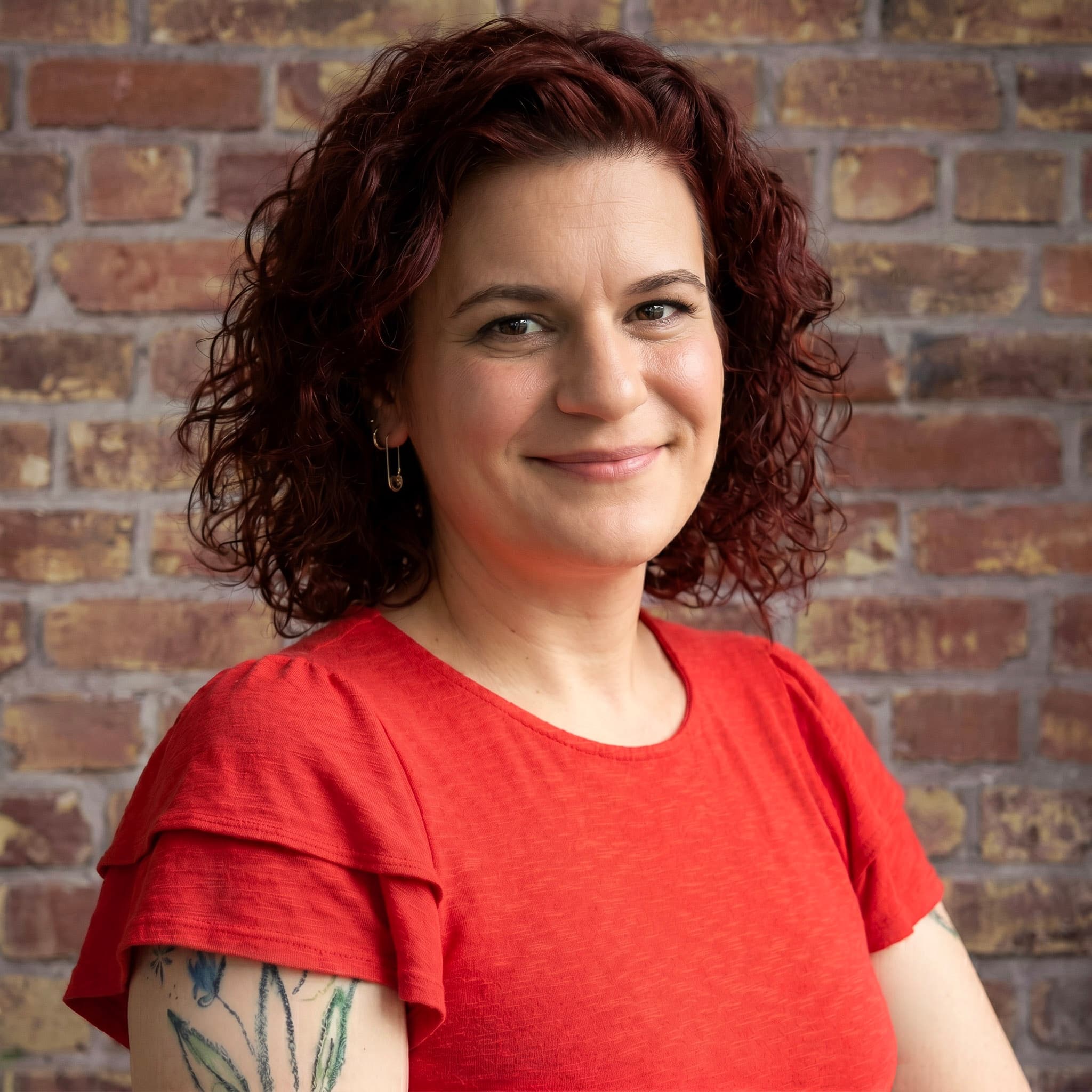
Angela DeGiaimo, LCSW
Angela is a therapist based in Brooklyn, NY specializing in anxiety, ADHD, people-pleasing, and the patterns that form when you've spent a long time pretending everything is fine. She has ADHD herself, which means she understands the experience from the inside. She works with adults via telehealth across New York State.